
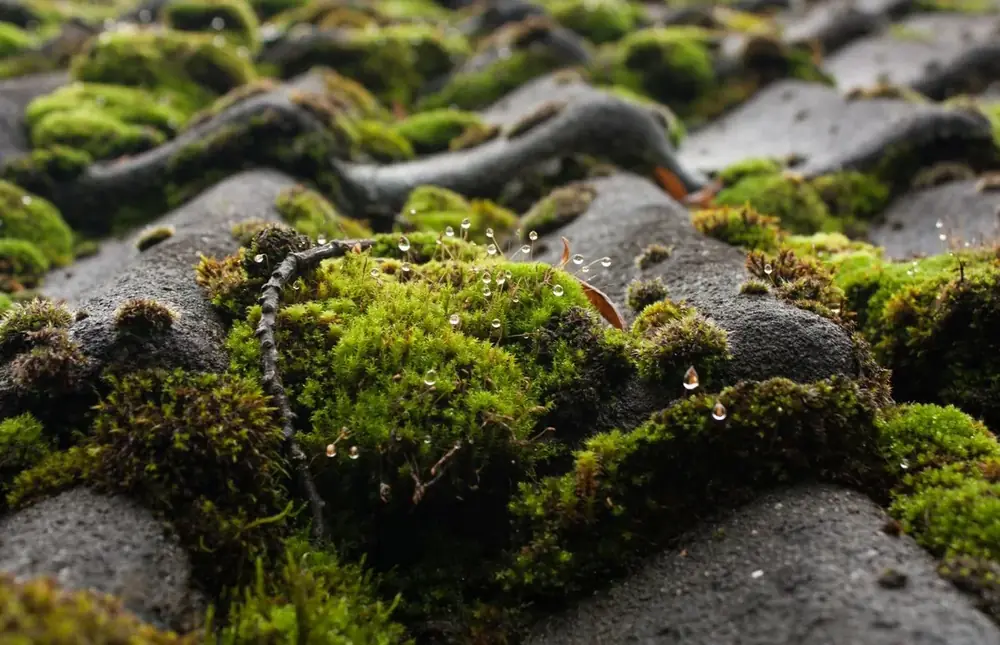
Almost every Shoreline homeowner calls all of it "moss." But the green fuzz, the black streaks, and the crusty spots are three different organisms — and treating the wrong one wastes your money. Here's the field guide.
Moss: Green, Soft, Spongy — the Damaging One
What it looks like: raised green clumps or thick mats, soft and spongy to the touch (don't touch it on a ladder — just look). Bright to dark green, often thickest on north-facing slopes and under tree branches.
What it does: this is the one that causes real damage. Moss grows tiny root-like structures (rhizoids) that work under shingle edges and pry them up. Lifted shingles let water underneath; trapped moisture rots the deck; winter freeze-thaw cracks waterlogged shingles. Thick moss is a structural problem, not a cosmetic one.
Treatment: manual removal of established mats first, then soft wash, then prevention treatment. Spray-only approaches leave dead moss acting as a moisture sponge.
Black Algae: Dark Streaks Running Downhill — the Cosmetic One
What it looks like: black or dark-brown streaks running vertically down the roof, following the water path. Flat — no height, no texture you can grab. Often starts on the north side and spreads.
What it does: the streaks are Gloeocapsa magma, a blue-green algae that feeds on the limestone filler in asphalt shingles. It's mostly cosmetic — it won't lift shingles like moss does. But it spreads fast in damp shade, it looks terrible, and heavy long-term colonization can contribute to granule loss.
Treatment: soft wash with an algaecide — no manual removal needed since there's nothing to grab. This is the easiest of the three to fix, and the results are dramatic.
Lichen: Crusty, Flat, Circular Spots — the Stubborn One
What it looks like: flat, crusty patches in pale green, gray, white, or orange — often roughly circular, like splatter. Feels cemented to the shingle; you can't brush it off with a finger.
What it does: lichen is a symbiotic organism (fungus + algae) that bonds tightly to the shingle surface. It doesn't lift shingles, but it's the hardest to remove safely — scraping it off takes granules with it. Its presence means that section of roof has stayed damp for a long time.
Treatment: soft wash with a dedicated lichen treatment, then patience — lichen often needs weeks to fully release after treatment. Aggressive same-day removal damages the shingles it's attached to. Anyone who promises to scrape lichen off "completely" in one visit is selling you granule loss.
| Moss | Black Algae | Lichen | |
|---|---|---|---|
| Look | Raised, green, spongy | Flat black streaks | Flat crusty spots |
| Damage level | High — lifts shingles | Low — mostly cosmetic | Medium — bonds to surface |
| Urgency | Soon | This season | Plan ahead |
| Removal | Manual + soft wash + treat | Soft wash + algaecide | Soft wash + time |
Can You Have All Three?
On an older Shoreline roof under firs — absolutely. Moss on the north slope, algae streaks below it, lichen spots on the sun-bleached south face. That's normal here, and it's why a proper inspection looks at the whole roof instead of quoting from the driveway.